Concentric Circles, Sacred Geometry and Yoga Asana

One of the fundamental expressions of nature, honored in sacred geometry, are  concentric circles radiating out from a center point. Drop a stone into a pond and watch how the wave train keeps extending on and on from the point of contact. Water is a wonderful medium for wave transition, and the human body is essentially 70% water. Recognize that, with every heart beat, waves radiate out from the heart, through your body, and on into the world around you. The heart produces a sound wave (try listening through a stethoscope!)
We can imagine concentric circles rippling out along the three major planes of the body (by rotating the surface of the pond). If we are standing, the first plane, the transverse, divides upper and lower, as if we were standing in the pond with water at heart level. Or, we can imagine floating in the pond and the circles extend out in a plane dividing front to back, the coronal plane. Finally, we can be on our sides the saggital plane dividing right and left, and follow the circles this way. Try this is any of your favorite poses. Let the concentric circles do the work.

On a larger scale we find the sun as the center of more concentric (almost) circles.

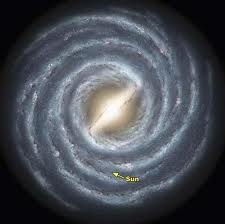
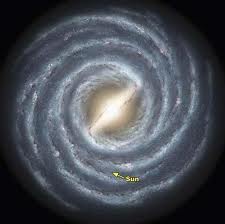
If  you are in a cosmic mood, feel that from the earth, there are circles in toward the sun, out out to mars and beyond. The planets orbiting makes the energy patterns more complex. This is of course subtle, especially for such a dense species as the modern human. But it is a glimpse of possibilities ready to awaken. If you are ready to go galactic, find the spiraling energies of the Milky Way, our home base here in the larger cosmos. This will wake up some memories.
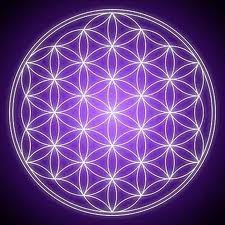
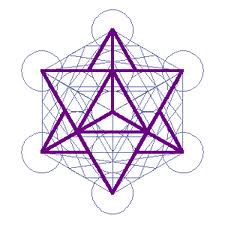
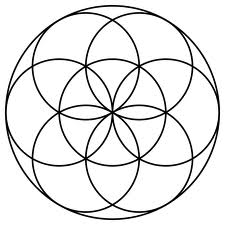
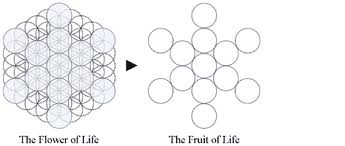
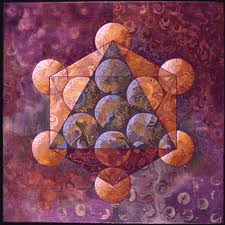
Speaking of awakening, the concentric circles and interwoven circles play a major role in the archetypal seed of life, flower of life and fruit of life symbols. In the seed of life below, we find a center circle which becomes the intersection point of six more circles of the same radius, each tangent to the next outer concentric circle. The flower of life adds a third circle, continuing the pattern of overlapping circles of the same radius. Embedded in the Flower of Life are the Fruit of Life which gives birth to Metatrons’ Cube, which, expanded into three dimensions, gives birth to the five Platonic solids and the star tetrahedron (a stellated version of the octahedron). 
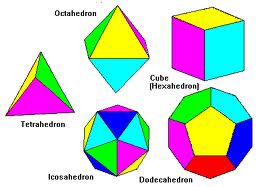
Finding these in the poses requires
a bit of imagination in the beginning as we visualize each vertex as a point of light and see how the soma, the living matrix of the body, responds. What is evoked? What opens? What confusion appears?

Find the interwoven triangles, squares and pentagons. Some poses may be more revealing, especially sitting, or restorative postures where you can rest quietly for some time. It is a treasure hunt. Good luck!
Cutting the Root of Ego

Dear Friends Near and Far:
I hope you have all been happy and healthy. I am in Guadalajara, Mexico preparing for todays Guru Rinpoche Day’s feast offering. I am going to keep each and everyone of you in my mind during the feast offering.
So for today’s Guru Rinpoche Day, I would like to share with you a key that helps unlock the root of all hope and fear. To really understand the dharma, to practice the dharma, and to apply the dharma, you really need to understand this key. On a day to day basis, where does all our hope and fear arise from? It arises from identity, feeling, belief, and ego clinging. The root is ego, this self centered ego.
What is hope? Hope is a positive attachment. When you don’t receive that or don’t have that you feel pain. What is Fear? Fear is something that you don’t like to have or don’t want to be. So most of our thoughts and feelings are contained in hope and fear.
Now I am going to give you a short quotation:
“Without cutting or reducing ego clinging, no matter how much you want to practice the dharma or live a positive life it is not going to work.”
As usual, my advice is don’t believe me but see it for your own self. So usually I say “seeing” is the first step, “recognizing” is the second step, “admitting” is the third step, “changing” is the fourth step and “measuring change” is the fifth step.
From another quotation:
“Without cutting the root of ego, meditation is just a creation of mind. Understanding is just labeling. Thinking that you understood is just subtle pride. When you really cut the root of ego, you don’t differentiate between yourself and others, and then you will understand selflessness. It is then when the realization of emptiness and compassion is going to be inseparable.”
So it is very important to reduce the ego. My message today may sound complicating to some, helpful to a handful and completely gibberish to many! But from my part, it is, has been, and will always be a joyful pleasure to connect with each and everyone of you and be a constant reminder of impermanence with each passing GRD one year after another.
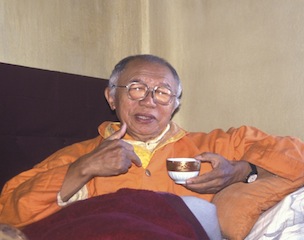
Enclosed is a picture of my grandfather, Tulku Urgyen Rinpoche pointing his finger inward. Thinking of you all and keeping you all in the depth of my heart and aspiration.

Sarva Mangalam,
Phakchok Rinpoche

for more on Phakchok Rinpoche, please see: www.phakchokrinpoche.org/

Krishnamurti on Love

Do you understand what simple love is ? Not the complexity of sexual love, nor the love of God, but just love, being tender, really gentle in one’s whole approach to all things. … But how is there to come into being this sensitivity which makes you alert not do do any harm to people, to animals, to flowers? Are you interested in all this? You should be. If you are not interested in being sensitive, you might as well be dead – and most people are. Though they eat three meals a day, have jobs, procreate children, drive cars, wear fine clothes, most people are as good as dead.

Do you know what it means to be sensitive? It means surely to have tender feelings for things…To be sensitive is to feel for people, for birds, for flowers, for trees – not because they are yours, but just because you are awake to the extraordinary beauty of things. …The moment you are deeply sensitive you naturally do not pluck the flowers; there is a spontaneous desire not to destroy things, not to hurt people, which means having real respect, love. To love is the most important thing in life. But what do we mean by love? When you love someone because that person loves you in return, surely that is not love. To love is to have this extraordinary feeling of affection without asking anything in return.

from Krishnamurti’s  “Think on These Things”, a series of essays originally published in 1964